Mostrando postagens com marcador Inovação. Mostrar todas as postagens
Mostrando postagens com marcador Inovação. Mostrar todas as postagens
quinta-feira, 13 de outubro de 2016


terça-feira, 15 de março de 2016
10 Invaluable Online Resources To Help You Start Your Own Creative Business
by Faith Towers on Feb 18, 2016
If you're contemplating starting your own
creative business but don't know where to begin, you're not alone. The prospect
of becoming your own boss can be a daunting one. So today I'm sharing ten
online resources that have been invaluable to me throughout my journey to
becoming a small business owner. And the best part? Most of them are free!
1. By Regina - This website
has a wealth of (free) information beyond just creating an action plan. Tips
for building an audience, being productive, creating an effective website, etc.Check out this awesome post here.
2. Coursera - This might be
one of my favorites. Coursera is a site with thousands of
university-level courses taught by real college professors. And every
course has a free option. I find the business and marketing courses to be
particularly helpful. Check it out here.
3. Dear Handmade Life - This
site sells affordable online workshops on a variety of creative subjects. See their current offerings here.
4. Lynda.com - This one has
a large selection of courses on topics ranging from business to
software to creative skills. And you can try it out for free for ten days. Head over here to check it out.
5. Wonderlass - This post
has a great step-by-step overview that will help you get started. There are
lots of other informative posts on the site as well. See this one here.
6. Freelancers Union - This
has a super helpful blog with all kinds of interesting information, as well as
resources for freelancers such as insurance information and discounts.Explore the site here.
7. Elegance and Enchantment -
This post would be helpful for those of you who are starting your own Etsy
shop. See all of Michelle's helpful tips
here.
8. Whitney Blake - This blog
post has five excellent tips for starting your own business, along with lots of
helpful links to additional resources. Read it here.
9. Skillshare - This site
has tons of useful video courses on a wide range of creative
business-focused topics. Check out their course listings here.
10. Creative Live - This is
another one of my favorites; they offer tons of different live courses which
are free if you watch them live, or you can buy any past course. Which means it
pays to keep an eye on their schedule! Check it out here.
Fonte: http://www.curbly.com/
terça-feira, 12 de janeiro de 2016
quarta-feira, 11 de fevereiro de 2015
A Smarter Way to Brainstorm
Ideally, a brainstorming session should be divided into two parts: the first for idea generation and the second for evaluation. During the idea-generation phase, no one is allowed to judge, criticize or squelch any of the ideas presented. Stay alert for nonproductive comments such as “We tried that last year” or “I don't think that will work.” Counter premature judgment with “This isn't the time for evaluation yet.”
As effective as brainstorming can be, remember there are many other collaborative techniques that stimulate creativity. Here are just a few:
As effective as brainstorming can be, remember there are many other collaborative techniques that stimulate creativity. Here are just a few:
- Metaphorical thinking is a great tool for breaking out of current patterns of perception. By comparing your situation to another better-understood system or process, you may spot similarities and come up with an unexpected idea. The exercise asks: “What can I learn from this comparison?” A classic example of this technique, from my book Creativity in Business, is of a defense contractor who developed a missile that had to fit so closely within its silo it couldn't be pushed in. Comparing the situation to a horse that refuses to be pushed into a stall, the solution was to lead the horse in. The solution for the defense company: pull the missile in with a cable.
- Forced connections is a technique for finding commonalities between two or more seemingly unrelated concepts or items. One practical exercise is to examine an industry that is very different from yours and to look for things you can successfully imitate. Another is to bring “show and tell” items that help you visualize the wide variety of options and materials that could be applied to the session’s topic.
- Back to the future starts with an image of the completed goal. Team members compare their answers to a series of questions: What does the ideal end result look like? How is the ideal different from what we have now? What changes are necessary for us to achieve the ideal? How can we make those changes?
Other suggestions:
- Get visual. Images stimulate emotion. The most productive creative-thinking sessions are extremely visual. They include mind mapping, sketching, diagrams, cartoons, and stick figures. Emotion opens creative channels that pure logic can't budge.
- Get physical. Get up and move around. Have your team stand rather than sit when grouping around white boards or easels. Act out the problem you are working on. A popular technique used by design firms is “body storming,” where people act out current behavior and usage patterns to see how they might be altered.
- Get fired. My favorite way to end a creativity session is to ask participants to take the last few minutes and contribute ideas that would probably work but are so outrageous they could get the group fired. (Obviously, the task then becomes to tone-down the potential solutions so that the problem can be solved without risking any jobs.)
Most importantly, you want to make sure that you are trying to solve the right problem. For example, the European operation of a business started losing money after many years of outstanding profitability. Worried, the management team initially discussed ways to reduce costs in Europe in order to improve profitability. When the cost-cutting did little to stop the downward slide, the team finally faced the real issue: the geographical distribution of customers had changed drastically. The problem was then redefined as “How do we serve our customers more profitably on a global basis?” Hundreds of ideas were generated around this challenge that resulted in a customer-focused business restructuring that not only cut costs in Europe but also added resources in other parts of the world
O que é excelência?
Por Fumiko Kouketsu
Nos dias de hoje, o mundo empresarial em todas as áreas tem falado muito em buscar a excelência. Mas o que precisamos saber é se realmente entendemos o significado dessa palavra. Excelência, diferentemente do que a maioria pensa, não é a perfeição. Mas buscar melhorar a cada dia nas pequenas coisas.
E sabe o que é mais interessante? Buscar a excelência não é um conceito novo, pelo contrário, quem falou nisso pela primeira vez foi o filósofo Aristóteles: “Somos o que repetidamente fazemos. A excelência, portanto, não é um feito, mas um hábito!”. Em japonês, diz-se Kaizen: kai (mudança) e zen (melhor), ou seja, melhoria contínua. O termo americanizado criado por Tony Robbins é Cani (pronuncia-se Canai) Constant and Never Endind Improvement. Então, temos boas notícias: você pode ser excelente todos os dias, e melhor, pode começar agora!
Podemos ser melhores pais e mães, amigos e profissionais. Você pode mudar seus hábitos, atitudes diárias, etc., nas coisas mais simples e corriqueiras, como: escovar os dentes com a torneira fechada, não jogar lixo na rua, tirar seu prato da mesa, entre outras. Atitudes simples, mas que podem fazer a diferença em sua vida. Você também pode mudar o seu comportamento: sorrir mais, ser mais gentil, agradecer mais vezes ao dia pelas coisas que você já tem, escutar mais, ser mais flexível, usar as "palavrinhas mágicas": com licença, muito obrigada, por favor, etc.
Experimente adotar esse comportamento apenas por um dia. Estou certo de que, se você fizer isso, vai perceber que as pessoas ao seu redor terão uma mudança incrível. E quer saber mais? Se tentar no segundo ou terceiro dia, vai descobrir que o responsável por essa mudança é você mesmo. Foi você quem mudou, as pessoas apenas retribuíram seu sorriso, sua gentileza. E, quando isso acontecer, muitas coisas boas começarão a ocorrer em sua vida.
quinta-feira, 20 de novembro de 2014
Inovação - Comentários Melhores livros 2014 segundo Strategy+Business
Erik Brynjolfsson and Andrew McAfee
The Second Machine Age: Work, Progress, and Prosperity in a Time of Brilliant Technologies
(W.W. Norton, 2014)
The Second Machine Age: Work, Progress, and Prosperity in a Time of Brilliant Technologies
(W.W. Norton, 2014)
Alex Pentland
Social Physics: How Good Ideas Spread—The Lessons from a New Science
(Penguin Press, 2014)
Social Physics: How Good Ideas Spread—The Lessons from a New Science
(Penguin Press, 2014)
These days, it seems as though every business challenge has the same solution: innovation. Innovation is the watchword for generating fast growth in the very slow recovery from the Great Recession, and, thanks largely to Clayton Christensen’s concept of disruptive innovation, it’s the narrative center of gravity in Silicon Valley and the rest of the global tech community. But if innovation is the answer, the obvious next question is how to innovate.
This year’s three best business books on innovation offer answers to this crucial query in intriguing and insightful, if sometimes indirect, ways. In The Second Machine Age, economist Erik Brynjolfsson and information technologist Andrew McAfee suggest that smart machines are not only the products of innovation, but also essential enablers of innovation prowess. In Social Physics, MIT data scientist Alex Pentland offers a data-driven and eye-opening inquiry into the flow of ideas among people. And in How Google Works, high-level company insiders Eric Schmidt and Jonathan Rosenberg, with Alan Eagle, take us down to where the rubber meets the road.
Innovation Cyborgs
In The Second Machine Age: Work, Progress, and Prosperity in a Time of Brilliant Technologies, Erik Brynjolfsson and Andrew McAfee of the MIT Center for Digital Business contend that we have entered an era during which machines will extend our mental powers in the same way that they’ve already extended our physical might. The authors point to Google’s driverless cars and Apple’s Siri as the early examples of what will soon be a flood of smart machines. The authors don’t map the exact channels that this flood will follow, but by showing how digital capabilities have become ever more sophisticated (and will continue to gain in sophistication in the future), they make a compelling case that smart machines will shift and blur the line between the human and digital domains. Routine tasks both manual and cognitive that were heretofore reserved for humans will increasingly become digitized.
Brynjolfsson and McAfee are convinced that the overall effect of smart digital technologies will be profoundly beneficial. They predict that the growth of these technologies will yield an exponential increase in the trajectory of human social development for the foreseeable future. As digital technologies are combined and recombined, abundance will replace scarcity as the norm in economics, bringing greater choice and freedom. For instance, digital technology should help us live more lightly on the planet than the machine technologies that preceded it.
Although it’s not a connection the authors make directly, the diminished physical scale of digital technologies, in comparison with their mechanical and human counterparts, is a major contributor to the authors’ principal concern for the future: the uneven distribution of the economic bounty that will accompany the second machine age. Machine technologies like the railroad and the automobile changed the physical landscape, which in turn created a vast ecology of new blue-collar and white-collar jobs. But the migration of work to computers will probably result in significant job losses. And if digital change occurs faster than displaced workers can acquire new skills, they may never catch up.
Further, because of the winner-take-all nature of digital innovation (recall that when Facebook acquired WhatsApp for US$19 billion, WhatsApp had only 55 employees), society could become highly polarized, with a small group of well-paid digital knowledge workers on one side, and on the other, a vast pool of low-paid service workers performing the non-routine tasks that computers can’t yet do. Median wages could be very low, indicating huge income disparities between the haves and the have-nots (see “Economics: All Things Being Unequal,” by Daniel Gross). These problems, together with the multiple significant changes in policy and practice required to address them, could place an enormous burden on governments.
The authors offer some recommendations for sidestepping these problems and prospering in the second machine age. They say that the focus of educational institutions and students should shift from rote learning to “the skills of ideation, broad-frame pattern recognition, and complex communication”—which machines can’t deliver, as yet. Governments should support basic research and offer prizes for innovation (like the kind awarded by DARPA that played such an important role in the development of driverless cars), adopt tax incentives to encourage employment, and radically reform economic metrics such as GDP that fail to capture much that is relevant to human well-being. They make a strong case, but I’d be remiss if I neglected to note that changing education curricula, financial incentives, and economic metrics are often accompanied by unintended consequences that are neither obvious nor benign.
Brynjolfsson and McAfee’s ultimate goal is the development of a “freestyle” civilization where people and machines work together to become powerful hybrids. As an example of such a hybrid, they cite chess, where computers can now routinely beat grandmasters, but grandmasters working with machines can muster a combination of strategic acuity and tactical knowledge that is more powerful still. If we translate this idea to the corporate arena, it suggests that in the future, a company’s competitive advantage will lie in the ability of its employees to sense and integrate while its computers are busy scanning and calculating.
Toward a Torrent of Ideas

Social Physics: How Good Ideas Spread—The Lessons from a New Science, by Alex “Sandy” Pentland, director of MIT’s Human Dynamics laboratory, offers a glimpse into the kinds of insights that the smart machines described in The Second Machine Age can help us surface. Pentland is a pioneer in social physics, a new science that uses big data and digital technologies to identify patterns and predict outcomes in social interactions. For instance, Pentland has developed an astonishing ability to predict the performance of teams in different situations based entirely on their nonverbal behavior and without knowing anything about the content of their conversations.
Although much of his work has been done with small groups, in Social Physics, Pentland scales up his findings to describe the dynamics of social learning and idea flow among people in large companies, cities, and society as a whole. He explains that social learning within a group—which includes the group’s ability to innovate—takes place when people adopt new strategies or acquire new beliefs through experience or observation. The critical determinant of social learning is idea flow—that is, the way in which ideas spread through the group. Pentland likens this to water: The idea flow within a group can be swift and clear or can take the form of a terrifying whirlpool or a stagnant pond.
The dynamic that drives idea flow is a continuous cycle of exploration and engagement. Exploration is the process of gathering ideas through exposure to a wide variety of experiences and ideas; engagement, which requires interaction and cooperation, is the sifting of those ideas and the conversion of those selected into action.
Pentland and his collaborators figured out how to detect ideas that are converted to action using electronic sociometric instruments. Briefly, the instruments measure energy, engagement, and exploration levels in groups, along with individual energy, extroversion, and empathy through body language. The researchers then couple that data with more conventional sources—such as surveys, purchasing records, and social network data. The result is a comprehensive view of social interaction patterns.
As social physics reveals more patterns, Pentland is most interested in applying them to cities. He’d like to see the creation of mobile sensing networks whose “eyes and ears” would be digital networks of wireless devices, such as mobile phones. These would be the basis, explains the author, of a “control framework: one that first senses the system; then combines these observations with models of demand and dynamic reaction; and finally uses the resulting predictions to tune the systems to match the demands being made on them.” Such a framework would help us understand and improve the rhythms of urban life, and quicken the pulse of exploration and engagement that is the signature of a vibrant, innovative community. In this regard, Pentland’s views on city design are supportive of those of urban activist Jane Jacobs, who fought the expressways and massive urban renewal projects of the mid-20th century, arguing that they destroyed communities and social capital.
Pentland envisions a future in which the science of social physics is used to design more human-centric cities. With the help of digital technology, he believes that urban design can be based on analysis at the individual level rather than averages and stereotypes. This will enable us to move beyond social classes to peer groups and beyond markets to exchange networks, where enhanced trust creates greater fairness and stability.
Of course, a mobile sensing nervous system depends on having a steady and wide-reaching flow of data. Pentland is cognizant of the privacy issues that this might entail and proposes a “new deal” on data in which individuals own their personal data, have full control over its use, and have the right to dispose of or distribute it as they see fit. As we’re seeing, however, this scenario is far easier described than done.
The patterns of interaction described in Social Physics also raise implications for executives who want to enhance the level of creativity and innovation in their companies. For example, instead of the current focus on employee cohesion, motivation, and satisfaction as drivers of idea flow, the book suggests that companies should provide employees with a wide diversity of exploratory experiences, coupled with periods of egalitarian engagement. Instead of the current emphasis on individuals and the content of communication, it suggests that companies should elevate their focus to groups and the modes of communication. And instead of using conventional organization charts, it suggests that companies should map idea flows.
Sandy Pentland’s Social Physics, with its emphasis on hard data, its view of organizations as dynamic processes, and the questions it raises about the entities on which organizations should focus—teams rather than individuals—is my choice for best business book of the year on innovation.
As Google Does

In How Google Works, Eric Schmidt and Jonathan Rosenberg, with the help of Google’s director of executive communications, Alan Eagle, take the reader on a guided tour through the inner workings of the tech giant. Schmidt and Rosenberg joined the company, as CEO and product senior vice president, respectively, in the early 2000s, after the venture capitalists who funded its initial growth realized that some “adult supervision” was in order.
The veteran IT executives quickly discovered the aversion of founders Sergey Brin and Larry Page to traditional management approaches, including the stage-gate process for managing new projects. In the Google Boys’ view, it slowed innovation down too much, constricting people in the process.
“Just talk to the engineers,” suggested Brin and Page. When Schmidt and Rosenberg did, they discovered that Google was staffed with “smart creatives”—digital knowledge workers who had deep technical know-how, broad management expertise, and business savvy. Realizing that imposing conventional control systems on such employees could be counterproductive, the newly hired execs decided to rethink their approach to management.
For one thing, they decided to manage the context for innovation rather than the content of innovation. “If you can’t tell someone how to think,” explain the authors, “then you have to learn to manage the environment where they think. And make it a place where they want to come every day.”
This meant that the design and management of Google’s culture became a top priority for Schmidt and Rosenberg, as did the design of the facilities (“boisterous, crowded offices, brimming with hectic energy”). They purposely maintained wide spans of control and organized the company around the people who had the highest impact on the organization (as measured by “performance and passion”), with the corporation retaining a simple, functional structure.
The idea is not to create a so-called star system, but a management system built around an ensemble. Reorganizations are undertaken often—with the participation of the employees being reorganized—and executed quickly in order to minimize disruption and uncertainty. And teams are purposely kept small; the authors say that they hew to Jeff Bezos’s “two-pizza rule” (a team should never be so large that it cannot be fed by two pizzas). Realizing that plans were bound to change often in an industry driven by fast-paced innovation, Google also adopted the VCs’ maxim to “invest in the team, not in the plan.” Using Pentland’s terms, one might say that the company seeks to promote social learning and idea flow by maintaining a constant pulse of exploration and engagement.
Unsurprisingly, in a company where talent drives innovation, Schmidt and Rosenberg tell us that hiring is an essential process at Google. They describe hiring as an egalitarian, peer-based activity that is tasked with an unabashedly elitist goal: Find the very best people and never let urgency compromise quality. Brilliant generalists—Rhodes scholars come in for special mention—are Google’s prime target. And the company subscribes to the view that hiring good people attracts good people, setting off a virtuous circle.
The big question for readers of this book is how transferable the Google experience is to their own company. It’s one thing to sustain a generative culture as a company grows, but, as the authors acknowledge, it’s much more difficult to revitalize a stagnant culture. Here their advice is brief and somewhat familiar: Find the smart people, understand how the existing culture is creating problems, encourage openness and difficult questions, and try to find something in the organization’s original culture that can take you where you want to go.
A closely related question is how sustainable Google’s culture of innovation is within Google itself. The authors clearly think that it is sustainable. But the histories of many innovation-driven companies that came before Google suggest that there is no sure inoculation against organizational sclerosis. Nonetheless, How Google Works should be read as an excellent case study in practical applications of some of the principles of social interaction described in Social Physics (note: the authors do not mention Pentland’s work).
All three of this year’s best business books on innovation point to digitization as the key enabler of progress at every level of society, and their authors evince an infectious optimism in this regard. But they also rightly acknowledge that digitization brings with it serious concerns: job losses and widening disparities in income, to say nothing of central issues involving trust and power that loom larger still. That is the other side of the coin—the possibility that digitization could produce a stultifying Taylorism ruled by George Orwell’s Big Brother.
This year’s three best business books on innovation pinpoint digitization as the key enabler of progress throughout society.
Surely the end result of digital innovation will fall somewhere between a digital utopia and a dystopia. The 18th-century German philosopher Immanuel Kant probably had it right when he wrote: “Out of the crooked timber of humanity, no straight thing was ever made.” 
Reprint No. 00291
AUTHOR PROFILE:
- David K. Hurst is a contributing editor of s+b and the author of several books, most recently The New Ecology of Leadership: Business Mastery in a Chaotic World (Columbia Business School Publishing, 2012).
Melhores livros de 2014 segundo a Strategy+Business Magazine
Best Business Books 2014
Enjoy the reading—then, put it to work.
 | Strategy Accelerate: Building Strategic Agility for a Faster-Moving World by John P. Kotter (Harvard Business Review Press, 2014) |
 | Marketing Tilt: Shifting Your Strategy from Products to Customers by Niraj Dawar (Harvard Business Review Press, 2013) |
 | Executive Self-Improvement Left Brain, Right Stuff: How Leaders Make Winning Decisions by Phil Rosenzweig (PublicAffairs, 2014) |
 | Organizational Culture The Circle by Dave Eggers (Knopf, 2013) |
 | Innovation Social Physics: How Good Ideas Spread—The Lessons from a New Science by Alex Pentland (Penguin Press, 2014) |
 | Sustainability The Big Pivot: Radically Practical Strategies for a Hotter, Scarcer, and More Open World by Andrew S. Winston (Harvard Business Review Press, 2014) |
 | Economics Capital in the 21st Century by Thomas Piketty, translated by Arthur Goldhammer (Belknap Press, 2014) |
quinta-feira, 7 de agosto de 2014
Dificuldades e soluções para começar a inovar
Entre a ideia e a
concretização dela há um espaço que é difícil para dimensionar e varia de
pessoa para pessoa. Não se trata de uma ciência exata e, portanto, tem forte subjetividade
e dependência do contexto e circunstâncias.
De acordo com pesquisas
recentes, 75% das startups que captaram recursos de terceiros falharam em dar retorno a esses
investidores, 95% delas falharam em atingir os resultados financeiros almejados
e mais de 50% não sobreviveu ao seu
sexto aniversário (fonte: livro).
Segundo Scott Anthony, autor do livro citado abaixo,
o maior desafio que os inovadores tem inicialmente é manter o equilíbrio entre
o pensamento e a execução. Segundo ele, os extremos são perigosos. De um lado
existe a paralisia da análise que envolve pesquisas intermináveis, dúvidas e
planos mirabolantes. Do outro lado,
fazer sem pensar. A velocidade da
execução e o crescimento são comprometidos se não há o entendimento dos
elementos chave do modelo de negócios.
O alvo mais importante é
encontrar os ingredients mágicos por trás da
grande ideia: a solução mais atraente para resolver uma necessidade de
uma forma que cria valor.
Livro:
The
First Mile: A Launch Manual for Getting Great Ideas into the Market (Harvard Business
Review Press, 2014)
quarta-feira, 29 de fevereiro de 2012
Imitação e inovação
O McDonald’s não é um caso raro de concorrente tardio que se tornou líder do mercado. Diferentemente da percepção comum, que confere exagerado peso aos inventores, os vencedores costumam chegar mais tarde. Dois professores da New York University, Gerard Tellis e Peter Golder, mostraram isso em uma análise histórica de 500 marcas em 66 mercados nos Estados Unidos entre 1856 e 1979. Durante os 123 anos examinados, o percentual de fracasso dos pioneiros foi de 47%. A fatia de mercado conquistada pelo inovador não passou, em geral, dos 10%. O líder de cada área entrou no mercado, em média, 13 anos depois do inovador. “Lembre-se que, na imitação, o timing não é tudo”, diz Shenkar, autor de Copycats. Nem é necessário se apressar para copiar. Em geral, é melhor uma cópia benfeita do que uma cópia ruim rápida.
Há, porém, uma diferença entre a imitação e a pirataria, afirma Yadong Luo. Muitos imitadores copiam apenas para abreviar o caminho da criação. As chinesas Haier (eletrodomésticos) e Huawei (telecomunicações), assim como as sul-coreanas Hyundai e Samsung, são casos bem-sucedidos de copycats que se tornaram inovadoras de presença global. Segundo Luo, para dar esse salto algumas habilidades são cruciais: a “combinação” (mesclar os recursos próprios com tecnologias e componentes do inovador a ser imitado), a “absorção” (assimilar e aplicar novo conhecimento) e o “networking” (formação de alianças estratégicas necessárias à operação). “A Embraer, terceira maior fabricante mundial de jatos civis, alcançou essa posição depois de um longo período de imitação criativa feita mediante parcerias globais”, disse.
Outra habilidade essencial para um copycat é a rapidez. A Tianyu, terceiro maior fabricante de celulares da China, leva menos de dois meses para colocar nas prateleiras um modelo imitação da Nokia ou Motorola. Da concepção à produção do modelo de celular, leva-se em média 45 dias, ante seis meses, ao menos, na Nokia. Copiar, é claro, é mais rápido do que criar: a Tianyu adota soluções prontas de tecnologia do setor de telecomunicação. É o modelo chamado em inglês de turnkey model (modelo em que basta girar uma chave): a solução tecnológica vem em “pacote fechado”. No departamento de Pesquisa e Desenvolvimento (P&D) da Tianyu, que emprega 600 profissionais, pesquisam-se formas cada vez mais rápidas de agilizar a implantação de processos e tecnologias... vindos de fora.
Segundo uma pesquisa da professora Femke van Horen, da Universidade de Colônia, na Alemanha, a imitação deslavada é um entrave à expansão das copycats – um dos fatores de ganho de musculatura é desenvolver certa originalidade, por moderada que seja. O recado parece ser: até para imitar é preciso ter ambição de criar algo.
Época Negócios fev12.
quarta-feira, 15 de fevereiro de 2012
Why you should come up with at least 1 bad idea today
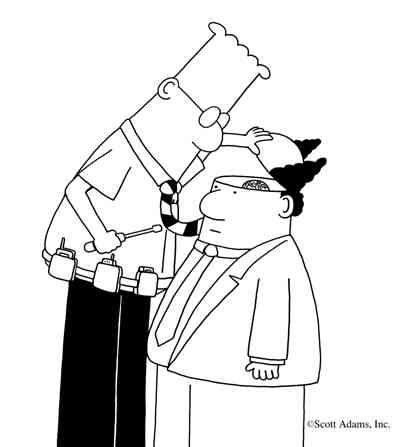 Many of us know that one secret to generating good ideas is producing bad ideas. But if you look on your bookshelf or visit the best creativity and productivity blogs – or even ask Mr. Google “how to come up with bad ideas” — you won’t find much guidance.
Thank goodness, then, for the brilliant and irrepressible Scott Adams. In a recent Wall Street Journal essay, the Dilbert creator borrowed from his experience as a television writer to suggest one of the best creativity exercises I’ve encountered.
Here’s his explanation:
I spent some time working in the television industry, and I learned a technique that writers use. It’s called “the bad version.” When you feel that a plot solution exists, but you can’t yet imagine it, you describe instead a bad version that has no purpose other than stimulating the other writers to imagine a better version.
For example, if your character is stuck on an island, the bad version of his escape might involve monkeys crafting a helicopter out of palm fronds and coconuts. That story idea is obviously bad, but it might stimulate you to think in terms of other engineering solutions, or other monkey-related solutions. The first step in thinking of an idea that will work is to stop fixating on ideas that won’t. The bad version of an idea moves your mind to a new vantage point.
In the piece, Adams uses the bad version process to suggest some provocative (and hilarious) ideas for reducing the US federal budget deficit. But the broader technique can apply to just about any creative stumbling block.
So give it a try. I think you’ll find that it’s not, er, a bad idea.
Daniel Pink
sexta-feira, 26 de agosto de 2011
O Ponto Negro : Somma Blog
Flávio Lettieri
“Certo dia, um professor chegou na sala de aula e disse aos alunos para se prepararem para uma prova relâmpago. Todos acertaram suas filas, aguardando assustados o teste que viria.
Depois que todos receberam, pediu que desvirassem a folha. Para surpresa de todos, não havia uma só pergunta ou texto, apenas um ponto negro, no meio da folha. O professor, analisando a expressão de surpresa que todos faziam, disse o seguinte:
Agora, vocês escreverão um texto sobre o que estão vendo.
Todos os alunos, confusos, começaram, então, a difícil e inexplicável tarefa. Terminado o tempo, o mestre recolheu as folhas, colocou-se na frente da turma e começou a ler as redações em voz alta. Todas, sem exceção, definiram o ponto negro, tentando dar explicações por sua presença no centro da folha.
Terminada a leitura, a sala em silêncio, o professor então começou a explicar: ‘Esse teste não será para nota, apenas serve de lição para todos nós. Ninguém na sala falou sobre a folha em branco. Todos centralizaram suas atenções no ponto negro.
Assim acontece em nossas vidas. Muitas vezes temos uma folha em branco inteira para observar e aproveitar, mas quase sempre nos centralizamos nos pontos negros.
Por vezes, esquecemo-nos que a vida é um presente, repleto de oportunidades e insistimos em olhar apenas para os pontos negros que surgem no caminho!”
Essa possibilidade de escolher qual o valor ou significado que daremos aos fatos, acontece a todo instante nas nossas relações em casa, com os amigos, com os familiares e, de forma bem evidente, em nosso ambiente de trabalho.
Diante do mesmo fato, diante do mesmo cenário, alguns focam nas dificuldades, outros nas oportunidades.
Alguns enxergam problemas, outros vêem soluções, afinal: “Enquanto alguns choram, outros vendem lenços”.
Por isso, é sempre bom termos em vista que o juízo ou a interpretação que damos aos acontecimentos nada mais é do que uma escolha pessoal.
Nós escolhemos se queremos nos manter presos ao ponto negro ou se colocaremos o nosso foco, a nossa atenção, a nossa energia, em toda a folha que continua em branco e com infinitas possibilidades.
E, sem dúvida, ser capaz, ou fazer a escolha, de manter o foco na solução é uma competência pessoal e, cada vez mais, uma necessidade profissional.
Mas, o fato é que muitos profissionais não têm essa competência.
A pergunta é: ‘O que eu devo ou posso fazer se eu tenho essa limitação pessoal’?
A resposta está, mais uma vez, nas nossas escolhas.
Alguns preferem fechar os olhos e fazer de conta que o problema não existe. Outros decidem encaram o problema de frente.
Qual a melhor escolha?
Certamente não há uma escolha melhor ou pior, apenas aquela que nos torna mais realizados, mais felizes.
Afinal, nesse caso, ao escolhermos encarar o problema de frente, surge uma nova escolha.
Para alguns, perceber-se sem essa competência pode se tornar algo realmente assustador. Um grande ponto negro que parece aumentar de tamanho à medida que essas pessoas olham para dentro de si!
Já para aqueles que compreendem que as nossas competências não nascem prontas, mas, ao contrário, são desenvolvidas a partir de nossa reflexão e do olhar que dirigimos para dentro de nós mesmos, lidar com essa descoberta passa a ser um desafio.
Ou, em outras palavras, escolhem aprender a escolher a folha em branco ao invés do ponto negro. Decidem mudar, para melhor.
Uma das coisas mais maravilhosas em sermos livres para fazer escolhas é que podemos nos reinventar a cada momento.
A todo instante podemos nos transformar em alguém melhor, mais preparado, mais competente.
Aprender a enxergar os fatos sob a perspectiva da oportunidade, eis aí um bom desafio…
quinta-feira, 25 de agosto de 2011
O conto dos países inovadores
Ideias e Inovação – Época NEGÓCIOS » O conto dos países inovadores » Arquivo
15:29, 23/08/2011
CLEMENTE NOBREGA
Todo grupo humano- seja um país, seja uma empresa – tem um sistema operacional que define o que o grupo pode de fazer. Que características tem de ter o sistema operacional de um país para que ele seja capaz de inovar?
A lista que compilei tem elementos que estão presentes em lugares tão diferentes como Suécia, Japão e Estados Unidos, por exemplo. Como Tolstoi poderia ter dito, os países inovadores são ricos de maneira muito semelhante – têm sistemas operacionais que geram os mesmos efeitos. Países não inovadores, porém, são pobres cada um à sua maneira. Seus sistemas operacionais “dão pau” cada um do seu jeito.
- - Se eu tivesse de resumir o que aprendi dos países que têm sistemas operacionais que promovem inovação, contaria a seguinte historinha:
-Nos países inovadores há um alto nível de confiança nas relações entre os indivíduos. Cooperação com base em reciprocidade é a norma mais arraigada nas relações sociais. Reciprocidade quer dizer: eu recebo proporcionalmente ao que dou. Alguém receber algo a que não faz jus não é tolerado, e não receber o que é justo em troca de uma contribuição legítima, também não é.
Quando a Enron foi para o brejo, a TV mostrou funcionários esvaziando gavetas aos prantos (por terem perdido empregos e fundos de aposentadoria) enquanto os chefões – que fraudaram e mentiram – saíam milionários. A raiva explodiu. O homem da rua, o pequeno José ou João (ou Joe) não entende de finanças, estratégias ou modelos de negócio. Precisa de autoridades que lhe orientem. Quando um cara chamado Kenneth Lay (ex-CEO da Enron), garantiu que ia torná-lo rico, Joe acreditou. Quando percebeu que foi traído, a raiva tomou conta. Kenneth Lay morreu semanas antes de ouvir sua sentença (que seria de 20 a 30 anos de prisão, no mínimo). O clamor público neste episódio pode ser comparado ao que ocorreu quando a TV mostrou o que, de fato, os EUA estavam fazendo no Vietnã. -Num país inovador a informação flui livremente. Há liberdade de comerciar e mercados livres. Mercados (regulados e controlados sempre que necessário) são essenciais. O que o colapso de grandes empresas têm mostrado, é que uma se pode até enganar seus reguladores, seus contadores, seus fornecedores, mas não se pode enganar o mercado. Ou a empresa dá um jeito de ganhar mais do que gasta ou vai desaparecer. Ela pode convencer seus financiadores a mantê-la à tona por um tempo, mas vai acabar afundando.
-Não há país inovador isolado do mundo. A energia empreendedora precisa de fronteiras abertas e estímulo para trocas e transações. Mas lembre-se: o mundo só vai confiar em você se você se provar confiável. A riqueza depende de reciprocidade. Silicon Valley é o ícone supremo da inovação, por sua cultura única de troca de informações entre engenheiros e pesquisadores (de empresas concorrentes!). Nem nos EUA há coisa igual. Os engenheiros mudam de emprego frequentemente, e ninguém liga por eles levarem segredos de uma empresa para outra. Direito à imaginação livre e competição baseada nela, imaginação.
O que garante o funcionamento do sistema operacional de países inovadores é a regra da lei (the rule of law). Um aparato jurídico que cuida para que as normas de convivência entre pessoas e instituições sejam seguidas por todos. Um funcionário mal remunerado de uma agência governamental americana pode processar Bill Gates e quebrar o monopólio da Microsoft. A corrupção é mantida em níveis mínimos. Em países inovadores, é legítimo e bom acumular posses individuais. O que é seu é seu. Direito à propriedade/ respeito à patentes é fundamental para induzir o investimento e a aceitação do risco por parte de pessoas e empresas. Mas países inovadores também penalizam fortemente os efeitos deletérios que a iniciativa individual possa trazer a quem não tem nada com isso. Não se admite nem pegar carona no esforço dos outros nem agir de forma a arriscar terceiros. Pirataria é crime sério. O início da reforma que está levando ao “capitalismo” chinês foi assim-os chineses passaram a ter direito de vender suas colheitas a quem pagasse mais. Países inovadores têm uma ética de trabalho arraigada, uma crença em melhorar de vida graças ao esforço pessoal. Meritocracia. A crença que a recompensa virá pelo esforço que cada indivíduo coloca nesse investimento. É assim que pensam as novas gerações de hindus e chineses que trabalham e estudam 15 horas por dia, sete dias por semana, ganhando muito pouco hoje, mas preparando-se para tomar conta do mundo amanhã. Em países inovadores a mentalidade “soma não zero” permeia toda a sociedade. Essa é uma norma cultural que diz que o bolo que existe hoje poderá crescer se houver colaboração. Minha vitória pessoal não se dá ás custas da derrota de outro. A mentalidade oposta, ”soma zero”, diz que o melhor é garantir logo sua fatia do bolo, antes que outro o faça. Não há visão de destino compartilhado, ganha quem tirar mais para si. Países inovadores valorizam a mentalidade científica e a racionalidade na busca de soluções; sociedades pobres tendem a abraçar o oculto e o mágico. Nessas,o religioso e o político se misturam. Acham que seu destino depende de salvadores messiânicos, ou da boa vontade dos deuses, não de seus esforços pessoais. Países inovadores têm lideranças mais pragmáticas, e menos ideológicas, que não hesitam em assumir posições impopulares para fazer o que deve ser feito. Países pobres têm versões diferentes daquilo que os antropólogos chamam de Big Men- lideranças truculentas que se impõe pela força, ou então populistas e carismáticos que manipulam a fraqueza e ignorância das multidões.Big Men se especializam em conchavos com grupos de interesse diversos, e seu objetivo único é ficar no poder (precisa de exemplos?).Finalmente, nas sociedades inovadoras há competição livre e um viés forte para experimentar e aprender com a experiência- uma forma saudável de se lidar com o erro. Sociedades não inovadoras tendem a se apegar ao certo, ao sem risco, ao garantido.
terça-feira, 2 de agosto de 2011
terça-feira, 26 de julho de 2011
10 Common Innovation Blunders IDEABANK- IDEAS FOR RESULTS
The fuzzy front end of innovation confronts you with a lot of questions. Many things can go wrong during the process of creating new products, services or business models. I give you ten examples. Perhaps it is a ‘feast of recognition’, which in this case is unfortunate but rest assured, you are not alone.
1. We don’t know what we want.
Ideation of new products and services happens ad hoc, usually at a time when a problem arises or the turnover decreases suddenly or when a competitor enters the market unexpectedly. The question is then: What now? ‘Jack Smith create a list’, becomes the creed. At this moment it becomes clear that the existing strategic business plan hardly provides footing or direction for innovation. This lack of clear answers leads to random thought processes, which in many cases are interrupted because the management, after consideration, decided to concentrate on either a different market, product or target group or on another country. When you are suddenly confronted with this during the creative process, it causes a spanner in the wheels of the creative car, which then, under loud protest, comes to a screeching halt.
2. We come up with the same thing over and over again.
Product and service ideas are not readily available. When there is a need for it, and at the initiative of a marketer in the organization, a few people are invited for a brainstorming session. This session usually takes place at the end of a long and tiring day. The people who come together are usually the same group (known as the creative team) but nothing materializes, because when you try and brainstorm with close colleagues nothing new appears. Everyone automatically races towards the same goal, they are irritated with the well-known hobbies of each other and the result is that everyone leaves the meeting disappointed. At these moments they all experience a feeling of failure, which nobody is able to prevent.
3. We remain in the usual conventions of our market.
Organizations usually have customer information at their disposal, do regular research into the market and are in contact with customers daily, but this investigative process has become routine. Companies pay more attention to their market shares and on what the competitor is doing on the same market. Therefore, products start looking alike as everyone copies each others’ successes which in turn leads to common conventions in the market while the organization looses sight of what the customer really wants. As a result of this tunnel vision, a ‘blind spot’ develops in the management from which a new competitor can appear at an unexpected moment with another offer, which might just meet the changing need of the market.
4. The brainstorm is dominated by extroverts and the highest bosses.
In a brainstorming session without expert facilitators not everyone is given a fair chance. In most cases either the extroverts or the highest bosses dominate it. This is extremely difficult and tactically awkward for the marketing manager who is faced with the problem of leading the meeting. It also applies when his boss has to have the final word in the brainstorm and the rest have been silenced.
5. Ideating and evaluating new product ideas goes haywire.
There are brainstorming sessions where everyone can have their say. After all, this is the reason for the brainstorming session, isn’t it? Indeed, when you carefully listen to what is being said and build upon the product ideas mentioned by others, however, the risk involved is that the ideas are judged immediately. Remarks such as: ‘That does not work with us’, ‘We have tried it before’, ‘We will never get permission to do that’, or ‘No that can definitely not be done’, are heard. In reality, due to these negative statements, it causes such a mix up where real creativity does not stand a chance, and a spiral of negativity is created whereby everyone is silenced within a short period of time as they are trapped amongst all the creativity killers.
6. With hundreds of yellow post-its on the wall we don’t know what to do next.
Often the person, usually the marketer who is responsible for the innovation itself, facilitates the brainstorming session. Soon product ideas are mentioned and in the end there is a wall full of post-its. But then the process stops, because what next? There might be good ideas amongst them but the question is: how do we create a product idea with a head and tail out of all of this? I must admit that in the days when I was still a manager, I did not have the answer to this question either and thought that I had to find the answers myself whereby I thanked all the participants for their input and took all the post-its to my office. Here they accusingly stared at me for weeks, until I finally threw them in the dustbin. Thus, many things can go wrong in a brainstorming session as the setting up and facilitating of a brainstorming program is a profession. This I learned much later, luckily.
7. Product or service ideas remain vague.
Due to the fact that everything in a brainstorming session, in the beginning, goes so well and creativity is stimulated, new product ideas are expressed in beautiful sounding marketing jargon. However, be aware as this can be a self-made pitfall. For example: ‘We are going to make an application whereby we can reach adolescents with trendy virtual mobile marketing’, or ‘It is going to become a very original product as it appeals to the primitive man inside us because it favors authenticity’. Product ideas in this stage, which can either represent everything or nothing, still have a long way to go.
8. Senior management is out to reject very innovative ideas.
At the beginning of the innovation pipeline, product ideas are screened. This is the task of the senior management who has the chance to influence the process afterwards. Even though the task is to really innovate, the ideas, which are considered as being too far fetched, are removed first, either because they cannot relate to it or because they believe it is really too far fetched, leaving the responsible executive managers in a daze. Real innovation was after all the intention, wasn’t it?
9. The development team puts everything back for discussion.
It is great when the decision is made to develop a good and new product idea. Subsequently it is passed on from the product inventors to the product developers – who are usually a multi-disciplinary team under the control of a project leader. It seems strange, but it is usually at this stage where most of the energy disappears from the idea. All the members of the development team now dissect the original product idea as everybody has their own vision as to which direction it should go. This is normal, isn’t it? Of course it is necessary to improve the product idea during the development process, but often the distinguished product idea starts looking more like ideas we have already had, only because we can produce something like that. The risk is that you then throw the baby out with the bathwater.
10. Line management always resist innovative ideas.
During the development process, the product idea has to be ‘sold’ to the line management on a regular basis. The reason being that should the product reach the finish line of the innovation process, they are the ones who will be producing the product and putting it on the market. So, while you are waiting for the expected applause, you continue to receive many comments and a pile of questions to which you do not have answers. It is logical that you would ask yourself whether these comments and questions are practical arguments or whether you have become the victim of the feared ‘not invented here’ syndrome. Maybe it is even a political game. Hence, it can happen that a good new product idea is kept in the freezer for years due to a lack of internal support. The resistance from the line management team can also be caused by the fact that they have more than enough to do with their regular tasks. And if they do not have the time to work on their own ideas then they are not prepared to spend time on the ideas of others, which has been forced upon them.
Conclusion
It is possible that you have recognized the above-mentioned situations, but do not despair because you are not the only one. And I have been working on a solution. I try to solve these 10 mistakes with the FORTH innovation method, which is recently published in my new book ‘Creating innovative Products and Services’.
You can also download thirteen free checklist of this innovation method here. I wish you lot’s of success in ideating new innovative products, services and business models.
1. We don’t know what we want.
Ideation of new products and services happens ad hoc, usually at a time when a problem arises or the turnover decreases suddenly or when a competitor enters the market unexpectedly. The question is then: What now? ‘Jack Smith create a list’, becomes the creed. At this moment it becomes clear that the existing strategic business plan hardly provides footing or direction for innovation. This lack of clear answers leads to random thought processes, which in many cases are interrupted because the management, after consideration, decided to concentrate on either a different market, product or target group or on another country. When you are suddenly confronted with this during the creative process, it causes a spanner in the wheels of the creative car, which then, under loud protest, comes to a screeching halt.
2. We come up with the same thing over and over again.
Product and service ideas are not readily available. When there is a need for it, and at the initiative of a marketer in the organization, a few people are invited for a brainstorming session. This session usually takes place at the end of a long and tiring day. The people who come together are usually the same group (known as the creative team) but nothing materializes, because when you try and brainstorm with close colleagues nothing new appears. Everyone automatically races towards the same goal, they are irritated with the well-known hobbies of each other and the result is that everyone leaves the meeting disappointed. At these moments they all experience a feeling of failure, which nobody is able to prevent.
3. We remain in the usual conventions of our market.
Organizations usually have customer information at their disposal, do regular research into the market and are in contact with customers daily, but this investigative process has become routine. Companies pay more attention to their market shares and on what the competitor is doing on the same market. Therefore, products start looking alike as everyone copies each others’ successes which in turn leads to common conventions in the market while the organization looses sight of what the customer really wants. As a result of this tunnel vision, a ‘blind spot’ develops in the management from which a new competitor can appear at an unexpected moment with another offer, which might just meet the changing need of the market.
4. The brainstorm is dominated by extroverts and the highest bosses.
In a brainstorming session without expert facilitators not everyone is given a fair chance. In most cases either the extroverts or the highest bosses dominate it. This is extremely difficult and tactically awkward for the marketing manager who is faced with the problem of leading the meeting. It also applies when his boss has to have the final word in the brainstorm and the rest have been silenced.
5. Ideating and evaluating new product ideas goes haywire.
There are brainstorming sessions where everyone can have their say. After all, this is the reason for the brainstorming session, isn’t it? Indeed, when you carefully listen to what is being said and build upon the product ideas mentioned by others, however, the risk involved is that the ideas are judged immediately. Remarks such as: ‘That does not work with us’, ‘We have tried it before’, ‘We will never get permission to do that’, or ‘No that can definitely not be done’, are heard. In reality, due to these negative statements, it causes such a mix up where real creativity does not stand a chance, and a spiral of negativity is created whereby everyone is silenced within a short period of time as they are trapped amongst all the creativity killers.
6. With hundreds of yellow post-its on the wall we don’t know what to do next.
Often the person, usually the marketer who is responsible for the innovation itself, facilitates the brainstorming session. Soon product ideas are mentioned and in the end there is a wall full of post-its. But then the process stops, because what next? There might be good ideas amongst them but the question is: how do we create a product idea with a head and tail out of all of this? I must admit that in the days when I was still a manager, I did not have the answer to this question either and thought that I had to find the answers myself whereby I thanked all the participants for their input and took all the post-its to my office. Here they accusingly stared at me for weeks, until I finally threw them in the dustbin. Thus, many things can go wrong in a brainstorming session as the setting up and facilitating of a brainstorming program is a profession. This I learned much later, luckily.
7. Product or service ideas remain vague.
Due to the fact that everything in a brainstorming session, in the beginning, goes so well and creativity is stimulated, new product ideas are expressed in beautiful sounding marketing jargon. However, be aware as this can be a self-made pitfall. For example: ‘We are going to make an application whereby we can reach adolescents with trendy virtual mobile marketing’, or ‘It is going to become a very original product as it appeals to the primitive man inside us because it favors authenticity’. Product ideas in this stage, which can either represent everything or nothing, still have a long way to go.
8. Senior management is out to reject very innovative ideas.
At the beginning of the innovation pipeline, product ideas are screened. This is the task of the senior management who has the chance to influence the process afterwards. Even though the task is to really innovate, the ideas, which are considered as being too far fetched, are removed first, either because they cannot relate to it or because they believe it is really too far fetched, leaving the responsible executive managers in a daze. Real innovation was after all the intention, wasn’t it?
9. The development team puts everything back for discussion.
It is great when the decision is made to develop a good and new product idea. Subsequently it is passed on from the product inventors to the product developers – who are usually a multi-disciplinary team under the control of a project leader. It seems strange, but it is usually at this stage where most of the energy disappears from the idea. All the members of the development team now dissect the original product idea as everybody has their own vision as to which direction it should go. This is normal, isn’t it? Of course it is necessary to improve the product idea during the development process, but often the distinguished product idea starts looking more like ideas we have already had, only because we can produce something like that. The risk is that you then throw the baby out with the bathwater.
10. Line management always resist innovative ideas.
During the development process, the product idea has to be ‘sold’ to the line management on a regular basis. The reason being that should the product reach the finish line of the innovation process, they are the ones who will be producing the product and putting it on the market. So, while you are waiting for the expected applause, you continue to receive many comments and a pile of questions to which you do not have answers. It is logical that you would ask yourself whether these comments and questions are practical arguments or whether you have become the victim of the feared ‘not invented here’ syndrome. Maybe it is even a political game. Hence, it can happen that a good new product idea is kept in the freezer for years due to a lack of internal support. The resistance from the line management team can also be caused by the fact that they have more than enough to do with their regular tasks. And if they do not have the time to work on their own ideas then they are not prepared to spend time on the ideas of others, which has been forced upon them.
Conclusion
It is possible that you have recognized the above-mentioned situations, but do not despair because you are not the only one. And I have been working on a solution. I try to solve these 10 mistakes with the FORTH innovation method, which is recently published in my new book ‘Creating innovative Products and Services’.
You can also download thirteen free checklist of this innovation method here. I wish you lot’s of success in ideating new innovative products, services and business models.
Assinar:
Postagens (Atom)