How to develop and retain leaders who can
guide your organization through times of fundamental change. See also
"Find Your Strategic Leaders.”
Illustration by Lars
Leetaru
Most companies have leaders
with the strong operational skills needed to maintain the status quo. But they
are facing a critical deficit: They lack people in positions of power with the
know-how, experience, and confidence required to tackle what management
scientists call “wicked problems.” Such problems can’t be solved by a single
command, they have causes that seem incomprehensible and solutions that seem
uncertain, and they often require companies to transform the way they do
business. Every enterprise faces these kinds of challenges today.
A 2015
PwC study of 6,000 senior executives, conducted using a research
methodology developed by David Rooke of Harthill
Consulting and William Torbert of Boston University, revealed just how
pervasive this shortfall is. Respondents were asked a series of open-ended
questions; their answers revealed their leadership preferences, which were then
analyzed to determine which types of leaders were most prominent. Only 8
percent of the respondents turned out to be strategic leaders, or those
effective at leading transformations (Rooke and Torbert refer to them as
“strategist” leaders).
Find Your
Strategic Leaders
Most companies lack people
in positions of power with the experience and confidence required to challenge
the status quo.
The study suggests that
strategic leaders are more likely to be women (10 percent of the female
respondents were categorized this way, versus 7 percent of the men), and the
number of strategic leaders increases with age (the highest proportion of
strategic leaders was among respondents age 45 and above). These leaders tend
to have several common personality traits: They can challenge the prevailing
view without provoking outrage or cynicism; they can act on the big and small
picture at the same time, and change course if their chosen path turns out to
be incorrect; and they lead with inquiry as well as advocacy, and with
engagement as well as command, operating all the while from a deeply
held humility and respect for others.
It may seem disheartening
that such a small percentage of senior leaders can operate this way. The trend
over time is almost as bad. When the same survey was conducted in 2005, only 7
percent of respondents were identified as strategic leaders. In other words, in
the course of a transformative decade marked by the collision of technological
breakthroughs, financial crises, demographic shifts, and other major global forces,
the leadership needle barely moved.
Given this small percentage
of senior leadership equipped to manage large-scale transformation, companies
are often forced to bring in leaders from outside. But as we’ve observed in
countless organizations over the years, significant change in a company is more
likely to succeed if it is led from within. Perhaps most alarming, the leadership
gap is typically hidden from view. No one recognizes that the company’s top
executives aren’t acting strategically, or people do realize it, but no one is
willing to call attention to the problem. The gap thus comes to light only when
a company faces a major challenge to its traditional way of doing business.
It’s in the do-or-die moments, when companies need a strategic leader most,
that they discover the current leadership isn’t up to the task.
A study of 6,000 senior
executives revealed that only 8 percent turned out to be strategic leaders.
Fortunately, companies can
build the capacity for strategic leadership. It starts with recognizing that
your organization undoubtedly already has emerging strategic leaders within it
whose skills are being overlooked or even stifled. The problem can be traced back
to how organizations traditionally promote and develop their leaders. In many
companies, the individuals who make their way to the top of the hierarchy do so
by demonstrating superlative performance, persistent ambition, and the ability
to solve the problems of the moment. These are valuable traits, but they are
not the skills of a strategic leader.
It’s in the do-or-die
moments that companies discover the current leadership isn’t up to the task.
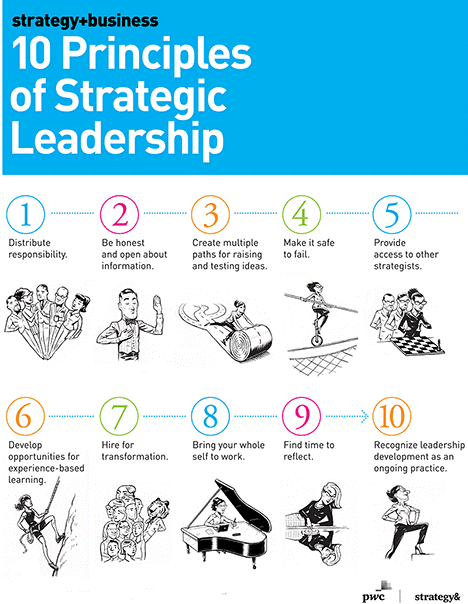
The following 10 principles
can help unlock the potential strategic leadership in your enterprise. These
principles represent a combination of organizational systems and individual
capabilities — the hardware and software of transformation. You may have already
adopted some of these tenets, and think that’s enough. But only when you
implement all of them together, as a single system, will they enable you to
attract, develop, and retain the strategic leaders who’ve eluded you thus far.
Systems and
Structures
The first three principles
of strategic leadership involve nontraditional but highly effective approaches
to decision making, transparency, and innovation.
1. Distribute
responsibility. Strategic leaders gain their skill through practice, and practice
requires a fair amount of autonomy. Top leaders should push power downward,
across the organization, empowering people at all levels to make decisions.
Distribution of responsibility gives potential strategic leaders the
opportunity to see what happens when they take risks. It also increases the
collective intelligence, adaptability, and resilience of the organization over
time, by harnessing the wisdom of those outside the traditional decision-making
hierarchy.
Top leaders should push
power downward, empowering people at all levels to make decisions.
In an oil refinery on the
U.S. West Coast, a machine malfunction in a treatment plant was going to cause
a three-week shutdown. Ordinarily, no one would have questioned the decision to
close, but the company had recently instituted a policy of distributed responsibility.
One plant operator spoke up with a possible solution. She had known for years
that there was a better way to manage the refinery’s technology, but she hadn’t
said anything because she had felt no ownership. The engineers disputed her
idea at first, but the operator stood her ground. The foreman was convinced,
and in the end, they
didn’t have to lose a single barrel of oil.
When individuals like the
plant operator are given this sort of responsibility and authority, they gain
more confidence and skill. When opportunities to make a difference are common
throughout an organization, a “can-do” proficiency becomes part of its identity.
At Buurtzorg, a Dutch
neighborhood nursing organization, most decisions are made by autonomous,
leaderless teams of up to a dozen nurses. A small central management team
supports and coaches the front-line nurses; there is no other middle
management. The company achieves the highest client satisfaction levels of all
community nursing delivery in the Netherlands, at only 70 percent of the usual
cost. Patients stay in care half as long, heal faster, and themselves become
more autonomous. And the nurses gain skills not just for leading their part of
the enterprise, but in community leadership as well.
2. Be honest and open about
information. The management structure traditionally adopted by large
organizations evolved from the military, and was specifically designed to limit
the flow of information. In this model, information truly equals power. The
trouble is, when information is released to specific individuals only on a
need-to-know basis, people have to make decisions in the dark. They do not know
what factors are significant to the strategy of the enterprise; they have to
guess. And it can be hard to guess right when you are not encouraged to
understand the bigger picture or to question information that comes your way.
Moreover, when people lack information, it undermines their confidence in
challenging a leader or proposing an idea that differs from that of their
leader.
Some competitive secrets
(for example, about products under development) may need to remain hidden, but
employees need a broad base of information if they are to become strategic
leaders. That is one of the principles behind “open-book management,” the
systematic sharing of information about the nature of the enterprise. Among the
companies that use this practice are Southwest Airlines, Harley-Davidson, and
Whole Foods Market, which have all enjoyed sustained growth after adopting
explicit practices of transparency.
Transparency fosters
conversation about the meaning of information and the improvement of everyday
practices. If productivity figures suddenly go down, for example, that could be
an opportunity to implement change. Coming to a better understanding of the problem
might be a team effort; it requires people to talk openly and honestly about
the data. If information is concealed, temptation grows to manipulate the data
to make it look better. The opportunity for strategic leadership is lost. Worse
still, people are implicitly told that there is more value in expedience than
in leading the enterprise to a higher level of performance. Strategic leaders
know that the real power in information comes not from hoarding it, but from
using it to find and create new opportunities for growth.
3. Create multiple paths
for raising and testing ideas. Developing and presenting ideas is a key
skill for strategic leaders. Even more important is the ability to connect
their ideas to the way the enterprise creates value. By setting up ways for
people to bring their innovative thinking to the surface, you can help them
learn to make the most of their own creativity.
This approach clearly
differs from that of traditional cultures, in which the common channel for new
ideas is limited to an individual’s direct manager. The manager may not
appreciate the value in the idea, blocking it from going forward and stifling
the innovator’s enthusiasm. Of course, it can also be counterproductive to
allow people to raise ideas indiscriminately without paying much attention to
their development. So many ideas, in so many repetitive forms, might then come
to the surface that it would be nearly impossible to sort through them. The
best opportunities could be lost in the clutter.
Instead, create a variety
of channels for innovative thinking. Some might be cross-functional forums, in
which people can present ideas to a group of like-minded peers and test them
against one another’s reasoning. There could also be apprenticeships, in which
promising thinkers, early in their careers, sign on for mentorship with leaders
who are well equipped to help them build their skills. Some organizations might
set up in-house courses or sponsor attendance at university programs. Reverse
mentoring — in which younger staff members share their knowledge of new
technology as part of a collaboration with a more established staff member —
can also be effective.
Google has made use of a number
of channels to promote innovation. A few examples:
Employees can email any of the leaders across the organization; the company
established “Google cafes” to spark conversation by encouraging interaction
among employees and across teams; and executives hold weekly all-hands meetings
(known as TGIFs) to give employees at every level in-person access to senior
leaders. People at Google learn to make the most of these opportunities — they
know the conversations will be tough, but that genuinely worthwhile innovative
thinking will be recognized and rewarded.
People,
Policies, and Practices
The next four principles
involve unconventional ways of thinking about assessment, hiring, and training.
4. Make it safe to fail. A
company’s espoused statement of values may encourage employees to “fail fast”
and learn from their errors. That works well until there is an actual failure,
leading to a genuine loss. The most dreaded phone call in the corporate world
soon follows; it’s the one that begins: “Who authorized this decision?” Big
failures are simply unacceptable within most organizations. Those who fail
often suffer in terms of promotion and reward, if not worse.
You must enshrine
acceptance of failure — and willingness to admit failure early — in the
practices and processes of the company, including the appraisal and promotion
processes. For example, return-on-investment calculations need to assess
results in a way that reflects the agreed-upon objectives, which may have been
deliberately designed to include risk. Strategic leaders cannot learn only from
efforts that succeed; they need to recognize the types of failures that turn
into successes. They also need to learn how to manage the tensions associated
with uncertainty, and how to recover from failure to try new ventures again.
Strategic
leaders need to recognize the types of failures that turn into successes.
One enterprise that has
taken this approach to heart is Honda. Like several other industrial companies,
the automaker has had a dramatic, visible failure in recent years. The
installation of faulty equipment from its favored airbag supplier, Takata, has
led Honda to recall about 8.5 million vehicles to date. Although the
accountable executives were fired, the company’s leaders also explicitly stated
that the airbag failure, in itself, was not the problem that led to dismissal.
The problem was the lack of attention to the failure at an early stage, when it
could have been much more easily corrected. As one Honda executivetold Jeffrey
Rothfeder, author of Driving Honda: Inside the
World’s Most Innovative Car Company (Portfolio, 2014) (and an s+b contributing editor), “We forgot that failure
is never an acceptable outcome; instead, it is the means to acceptable
outcomes.”
Some organizations have
begun to embrace failure as an important part of their employees’ development.
The Bill & Melinda Gates Foundation and the U.K.-based innovation charity
Nesta have held “failure fests,” at which employees discuss decisions that went
wrong and derive lessons from them. In addition to establishing such forums,
you can provide managers with opportunities to oversee smaller change
initiatives, some of which may not work out, to develop the skills they’ll need
to lead larger-scale transformations.
5. Provide access to other
strategists. Give potential strategic leaders the opportunity to meet and work
with their peers across the organization. Otherwise, they remain hidden from
one another, and may feel isolated or alone. Once they know that there are
others in the company with a similar predisposition, they can be more open —
and adept — in raising the strategic value of what they do.
The first step is to find
them. Strategic leaders may not be fully aware themselves that they are
distinctive. But others on their team, and their bosses, tend to recognize
their unique talents. They may use phrases like “she just gets it,” “he always
knows the right question to ask,” or “she never lets us get away with thinking
and operating in silos” to describe them. A good way to learn about candidates
is to ask, “Who are the people who really seem to understand what the
organization needs — and how to help it get there?” These may be people who
aren’t traditionally popular; their predisposition to question, challenge, and
disrupt the status quo can unsettle people, particularly people at the same
level.
Of course, you don’t want
to create the impression that some people deserve special treatment. Instead,
cultivate the idea that many managers, perhaps even most, have the potential to
become strategic leaders. Then bring the first group together. Invite them to
learn from one another, and to explore ways of fostering a more strategic
environment in the rest of the enterprise.
6. Develop opportunities
for experience-based learning. The vast majority of professional leadership
development is informative as opposed to experiential. Classroom-based training
is, after all, typically easier and less expensive to implement; it’s evidence
of short-term thinking, rather than long-term investment in the leadership pipeline.
Although traditional leadership training can develop good managerial skills,
strategists need experience to live up to their potential.
One vehicle for creating
leadership experiences is the cross-functional “practice field,” as organizational
learning theorist Peter Senge calls it. Bring
together a team of potential strategic leaders with a collective assignment: to
create a fully developed solution to a problem or to design a new critical
capability and the way to generate it. Give them a small budget and a
preliminary deadline. Have them draw plans and financial estimates of their
solutions. Then run the estimates through an in-depth analysis. This project
might include a simulation exercise, constructed with the kind of systems
simulation software that has been used to model and participate in wargames
since the 1980s. You can also let reality be their practice field. Have them
create the new capability or initiative on a small scale, and put it into
effect. Then track the results assiduously. Assign mentors with experience to
help them make the most of their effort — without sidetracking it.
Whether you set up the
project in reality or as a simulation, the next step should be the same.
Schedule a series of intensive discussions about the results. Explore why these
results appeared, what the team might have done differently, and how things
could be different in the future if the group changed some of the variables.
The goal is to cultivate a better understanding than would be possible without
this type of reflection, and to use that understanding as the basis for future
efforts.
7. Hire for transformation. Hiring
decisions should be based on careful considerations of capabilities and
experiences, and should aim for diversity to overcome the natural tendency of
managers to select people much like themselves.
Test how applicants react
to specific, real-life situations; do substantive research into how they
performed in previous organizations; and conduct interviews that delve deeper
than usual into their psyche and abilities, to test their empathy, their
ability to reframe problems, and their agility in considering big-picture
questions as well as analytical data. In all these cases, you’re looking for
their ability to see the forest and the trees: their ability to manage the
minutiae of specific skills and practices, while also being visionary about
strategic goals. The better they are at keeping near and far points of view
simultaneously available, the better their potential to be strategic leaders.
For those hired, the
on-boarding processes should send explicit signals that they can experiment,
take on more responsibility, and do more to help transform the organization
than they could in their previous career. They need to feel that the culture is
open to change and to diverse views.
The final three principles
are aimed at the potential strategic leaders themselves — these tactics can
help them prepare for their personal evolution.
8. Bring your whole self to
work. Strategic
leaders understand that to tackle the most demanding situations and problems,
they need to draw on everything they have learned in their lives. They want to
tap into their full set of capabilities, interests, experiences, and passions
to come up with innovative solutions. And they don’t want to waste their time
in situations (or with organizations) that don’t align with their values.
Significantly, they
encourage the people who report to them to do the same. In so doing, strategic
leaders create a lower-stress environment, because no one is pretending to be
someone else; people take responsibility for who they truly are. This creates
an honest and authentic environment in which people can share their motivations
and capabilities, as well as the enablers and constraints in their life.
9. Find time to reflect. Strategic
leaders are skilled in what organizational theorists Chris
Argyris and Donald Schön called “double-loop learning.” Single-loop
learning involves thinking in depth about a situation and the problems inherent
in it. Double-loop learning involves studying your own thinking about the
situation — the biases and assumptions you have, and the “undiscussables” that
are too difficult to raise.
Your goal in reflection is
to raise your game in double-loop learning. Question the way in which you
question things. Solve the problems inherent in the way you problem-solve.
Start with single-loop learning, and then move to double-loop learning by
taking the time to think: Why did I make that decision? What are the
implications? What would I do differently next time? How am I going to apply
this learning going forward?
Reflection helps you learn
from your mistakes, but it also gives you time to figure out the value of your
aspirations, and whether you can raise them higher. It allows you the chance to
spot great ideas using what you are already doing or things that are going on
in your life. Managers are often caught up in the pressures of the moment. A
mistake or a high-pressure project can feel overwhelming. But if you take a
minute to step back and reflect on these problems, it can provide the space to
see what you did right.
Some reflection is more
productive than others. Psychologists warn about “rumination,” or dwelling on
deceptive messages about your own inadequacies or the intractability of
problems in a way that reinforces your feeling of being stuck. To avoid this
pattern, deliberately give yourself a constructive question to reflect on. For
example, what are the capabilities we need to build next? How can I best
contribute? Human capital teams can help by training individuals in these
practices and ensuring that all managers support their team members who take
the time to reflect.
10. Recognize leadership
development as an ongoing practice.Strategists have the
humility and intelligence to realize that their learning and development is
never done, however experienced they may be. They admit that they are
vulnerable and don’t have all the answers. This characteristic has the added
benefit of allowing other people to be the expert in some circumstances. In
that way, strategic leaders make it easy for others to share ideas by
encouraging new ways of thinking and explicitly asking for advice.
Strategists have the
humility to realize that their learning and development is
Their thirst for learning
also gives potential strategists the space to be open to less obvious career
opportunities — new industries, different types of roles, lateral moves,
stretch assignments, secondments, or project roles — that may help them fulfill
their potential.
At some point, you may
advance to the point where you are not concerned solely with your own role as a
strategic leader, but with cultivating opportunities for others. This will
require a clear-eyed, reflective view of the talent pool around you. It isn’t
easy for any leader to accept that others in the company may not have what it
takes. Or, worse, to learn that the people with the potential to demonstrate
leadership feel constrained by current organizational practices, and they are
taking their talents elsewhere.
But if you can come to
terms with reality, as uncomfortable as it may be, then you’re in a position to
help change it. By following the 10 principles we’ve outlined here, you will
give yourself the skill and influence to pave the way for others who follow.
That’s fortunate, because the ability to transform amid societal and business
challenges and disruptions is essential to your company’s success — and perhaps
even to its survival.
Fonte: Stategy
Author
Profiles:
·
Jessica Leitch is a senior manager
with PwC UK., and is based in London. She specializes in culture change,
workforce transformation, and helping leaders make a positive impact on their
organization and on society.
·
David Lancefield is an
advisor to executives on transformational change for Strategy&, PwC’s
strategy consulting group. Based in London, he is a partner with PwC UK. He
focuses on helping companies shape their future and translate strategic intent
into everyday activities, working extensively in the media industry.
·
Mark Dawson is a partner
with PwC UK, and is based in London. He leads PwC’s people and organization
consulting practice in the U.K., advising retail, consumer, and financial
clients on transformational leadership and organizational effectiveness, and
aligning strategy, organization, and behaviors.