terça-feira, 21 de julho de 2015

Caminhos da Amazon para dominar o mundo | Endeavor Brasil

Caminhos da Amazon para dominar o mundo | Endeavor Brasil


Confira as iniciativas que têm garantido o domínio do marketplace da Amazon pelos quatro cantos do planeta.

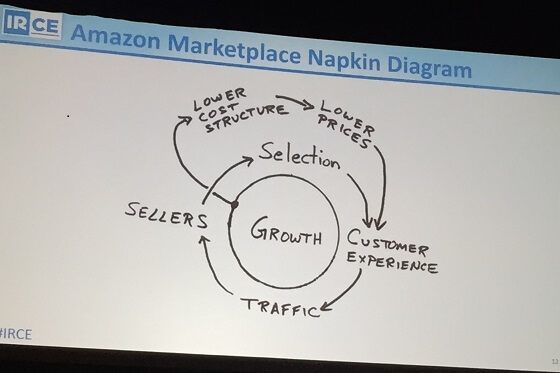
Quanto mais produtos, mais experiência para o consumidor, mais tráfego, mais vendedores, mais crescimento, menos custo, mais preço baixo, e por aí vai… A estratégia da Amazon é tão preto-no-branco que foi escrita em um guardanapo pelo Jeff Bezos. Na imagem, está seu Círculo Virtuoso do Crescimento:
amaz1
Para implementar o Círculo Virtuoso, a Amazon tem investido em quatro elementos-chave: Marketplace, Prime, Fullfilment e Web Services – todos tratados com detalhes no IRCE – Internet Retailer Conference and Exhibition -, considerado o maior evento de e-commerce do planeta, que concentra o que há de melhor do mundo online em termos de novidades, produtos, serviços, palestras, exibidores e participantes.
Esse ano, os destaques do IRCE foram gestão de pessoas, personalização, internet das coisas e, claro, o domínio do marketplace da Amazon – sobre esse último, reúno abaixo os principais conceitos e estratégias do ecossistema dessa gigante americana.
O Crescimento da Amazon
A previsão é que, em 2015, a Amazon terá feito 200 bilhões de dólares de GMV (gross merchandise volume, ou faturamento total movimentado), sendo 40% como varejista e 60% pelo marketplace. A previsão é que a porcentagem correspondente às vendas pelo marketplace suba para 90% em até 5 anos.
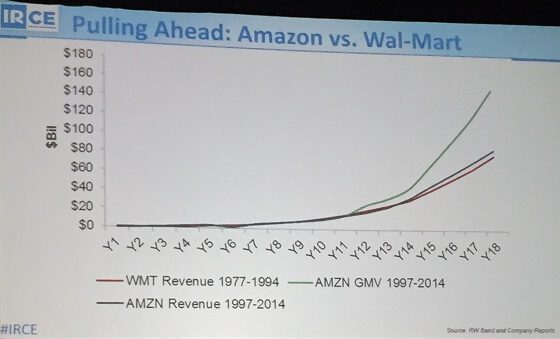
O CRESCIMENTO DA AMAZON VEM APONTANDO UMA CURVA EXPONENCIAL DESDE 2006, ANO DE LANÇAMENTO DO MARKETPLACE.
O gráfico abaixo mostra, inclusive, o descolamento do GMV da Amazon em comparação à receita do Walmart, considerando os primeiros anos de cada uma das empresas. Analistas preveem que, em 2022, a Amazon supere o Walmart em receita bruta total.
amaz2
Amazon Prime
A Amazon possui 300 milhões de consumidores. 10% deles já estão no programa Amazon Prime, que também cresce exponencialmente devido aos serviços ofertados. Eles pagam 99 dólares por ano e tem acesso a:
- milhões de produtos com entrega grátis em até dois dias – centenas de milhares de produtos com entrega grátis no mesmo dia, incluindo Amazon Fresh, produtos perecíveis de supermercado. – Amazon Studio: estúdio próprio em que a Amazon está desenvolvendo neste momento mais de 3.000 projetos de vídeo, como filmes e séries – Amazon Prime Instant Video: para concorrer com a Netflix, possui mais de 17.000 filmes e séries – Amazon Prime Music: para concorrer com Spotify, possui mais de 1 milhão de músicas para ouvir via streaming – Amazon Prime Photos: armazenamento ilimitado de fotos – Acesso a mais de 500.000 ebooks gratuitos
Esses consumidores Prime têm o comportamento de pesquisar produtos diretamente na Amazon, sem sequer passar pelo Google. É uma excelente estratégia para gerar receita recorrente e criar uma base de clientes fidelizados.
Sortimento
A Amazon já possui mais de 320 milhões de produtos à disposição do consumidor, tendo esse número dobrado no últimos 2 anos. 80% desses produtos estão disponíveis no marketplace. A tendência é que, no médio prazo, a Amazon fique com apenas 3% dos produtos como varejista, que serão os top sellers e/ou lançamentos, para que ela possa controlar o preço e a disponibilidade. Todos os demais produtos serão comercializados pelos vendedores no marketplace.
Amazon Advertising
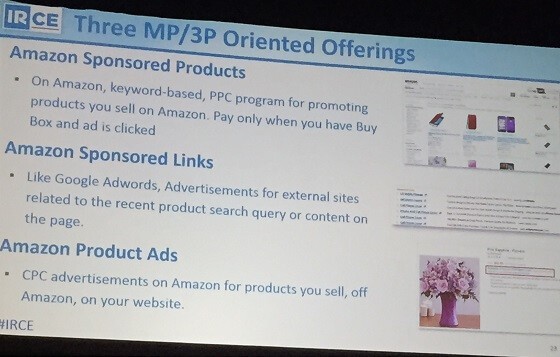
A plataforma de publicidade da Amazon já está faturando 1 bilhão de dólares e vem forte para concorrer com o Google Ads. Já começam a se formar especialistas em search, paid search e SEO na Amazon!
amaz3
Amazon Web Services (AWS)
A AWS já está faturando 8 bilhões de dólares e a Amazon tem gastado cada vez menos em marketing, quando comparado com os gastos em tecnologia. Fica claro que hoje a AWS e a Advertising (que possuem altas margens) estão subsidiando o varejo. É possível que, num futuro próximo, a curva de rentabilidade se inverta e a Amazon tenha um crescimento astronômico que a faça ir finalmente para o azul.
FBA (Fullfilment by Amazon)
A unidade de operação e logística da Amazon, que inclui os Fullfilment Centers (para armazenagem) e Centros de Distribuição, já responde por 18 bilhões de dólares de faturamento da gigante. Já são 150 unidades em 11 países. Há indícios que Austrália e México serão os próximos. Nos últimos 4 anos, o custo de frete tem estado estável entre 4% e 5%. Este ponto é fundamental para o Círculo Virtuoso, porque se você é vendedor do marketplace e utiliza o FBA, você tem prioridade nas buscas do Prime pelo consumidor, podendo inclusive ganhar o Buy Box – a parte privilegiada da descrição do produto que direciona para vendedores que oferecem a melhor experiência para o comprador. Neste ponto, o domínio do local e das últimas etapas da cadeia é outro aspecto fundamental para o sucesso da estratégia da Amazon.
Novos produtos
Além do Fresh, Studios, Music, Photos, Instant Videos já citados acima, fiquem atentos ao Amazon Dash, Amazon Echo, Prime Now, Home Services, Amazon Destinations e o impressionante Amazon Trunk Delivery, que é a próxima inovação: em uma parceria com a DHL e a Audi, a Amazon começará a entregar diretamente na mala do seu carro estacionado!
E falando em DHL, eles já lançaram o piloto do Drone com entregas na Alemanha:

amaz4
Há boatos que a Amazon também começará a entrega com seus próprios drones em 2017, na Índia. Serão drones de baixa altitude, baixa velocidade e controlados por monitoramento terrestre. O futuro já chegou!
Precificação Dinâmica no Marketplace
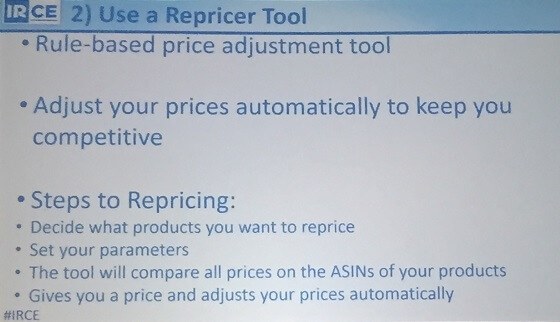
Acompanho os eventos americanos de e-commerce desde 2011 e nunca vi tanta palestra abordando o tema de precificação dinâmica! Foram mais de 5 palestras em que diversos varejistas relatam suas experiências e atestam a importância de se utilizar plataformas de inteligência de preços e sortimento, em especial no marketplace da Amazon, porque isso também ajuda a ganhar o buy box!
amaz5
Neste post aqui, eu conto o que aprendi quando visitei a sede global da Amazon e conversei com o vice-presidente de pricing.
Uma Virada no Modelo de Negócios
A AMAZON ESTÁ CADA VEZ MAIS RELEVANTE NO MERCADO AMERICANO, NITIDAMENTE MIGRANDO DE VAREJISTA B2C PARA UMA EMPRESA DE TECNOLOGIA B2B PRESTADORA DE SERVIÇOS.
Isso vem acontecendo a partir das sinergias do círculo virtuoso do modelo de Marketplace, Prime, FBA e AWS, com alta taxa de crescimento dos varejistas (vendedores) e de recorrência dos consumidores.
O marketplace já é a plataforma dominante do e-commerce americano. Tudo indica que ocorrerá o mesmo no Brasil, com uma expansão acelerada dos players envolvidos, já que todos saem ganhando: marketplace, vendedores e consumidores.


sexta-feira, 24 de abril de 2015

Investing in tech startups to the masses

Published: Apr 23, 2015 1:22 p.m. ET
By Wallace Witkowski
http://www.marketwatch.com/

Venture capitalists are always looking for the next big investment in tech, whether it’s cloud-computing, data analysis, or software development. But a growing trend in startup funding seeks to give the smaller retail investor a shot at getting in on the ground floor of the next Google or Facebook.
It used to be that tech companies like VMware Inc. VMW, -2.07%  sought how to take large servers and cut them up into tiny virtual computers. Now, with smartphones and wearable devices like Apple Inc.’s AAPL, +0.42%  Apple Watch or FitBit fitness trackers, the new hot companies are those taking the data collected from these devices and turning it into a meaningful database and products that customers can use.

In much the same way, aggregating a lot of little pieces to form value may be the future of investing in tech startups. Onevest, which presented at DEMO’s Traction startup conference in San Francisco on Wednesday, seeks to do just that by making seed-fund investing in startups available to retail investors who normally wouldn’t have the funds or access to do so. It’s crowdfunding — but with equity.

Crowdfunding sites like Kickstarter have gained in popularity as a way for people to invest in companies they believe in and products they want to see come to market. But a major criticism of the Kickstarter model is that backers get some sort of token appreciation for their support, rather than equity in the investment. One of the biggest gripes from Kickstarter “investors” in Oculus Rift was that they pledged money to the company to help bring a virtual reality headset to market, only for the company to get acquired by Facebook Inc. FB, +0.59%  for $2 billion.

“We’re giving people the possibility to invest in companies instead of buying T-shirts,” said Alejandro Cremades, co-founder of Onevest, in an interview.
Another thing that sets Onevest apart from other crowdfunding sites is they’re getting involved with building the startups themselves. Last year, Onevest acquired CoFoundersLab, essentially an entrepreneur matchmaking service aimed at bringing together compatible startup teams. One CoFoundersLab success story wassmart-home gadget startup Revolv, which was acquired by Google Inc.GOOG, +2.99%  in October.

For now, only “accredited investors,” meaning households that make at least $200,000 a year or have $1 million in assets, in the U.S. can invest in startups, Cremades said. That’s slated to change soon with implementation of Securities and Exchange Commission regulations under the JOBS Act, which would allow investors who fall below those conditions to invest in startups.
 “I believe the next-generation data center, the world of aggregation and connectivity of lots of little pieces connected together, will be the future of computing,” said Peter Levine, general partner at venture capital firm Andreessen Horowitz, at the DEMO conference.
This outlook raises the stakes for data-analytics companies, which have to parse huge amounts of data and make it meaningful for applications; security companies, to ensure the data doesn’t fall into the wrong hands; and software developers, which will create the new apps and services based on all that data.
Wearable computers, which are about where smartphones were back around the iPhone’s introduction in 2007, are expected to dramatically hike the volume of data available for companies to reap for profit.
Erick Schonfeld, executive producer of DEMO, likened wearable devices to human odometers.

“We’re becoming endpoints ourselves, we’re creating data exhaust from our own bodies,” Schonfeld said. Case in point, companies like Oscar Insurance Corp. are already offering customers discounts on health insurance if they wear a fitness tracking device, he said.

quarta-feira, 11 de fevereiro de 2015

A Smarter Way to Brainstorm

Ideally, a brainstorming session should be divided into two parts: the first for idea generation and the second for evaluation. During the idea-generation phase, no one is allowed to judge, criticize or squelch any of the ideas presented. Stay alert for nonproductive comments such as “We tried that last year” or “I don't think that will work.” Counter premature judgment with “This isn't the time for evaluation yet.”

As effective as brainstorming can be, remember there are many other collaborative techniques that stimulate creativity. Here are just a few:
  • Metaphorical thinking is a great tool for breaking out of current patterns of perception. By comparing your situation to another better-understood system or process, you may spot similarities and come up with an unexpected idea. The exercise asks: “What can I learn from this comparison?” A classic example of this technique, from my book Creativity in Business, is of a defense contractor who developed a missile that had to fit so closely within its silo it couldn't be pushed in. Comparing the situation to a horse that refuses to be pushed into a stall, the solution was to lead the horse in. The solution for the defense company: pull the missile in with a cable.
  • Forced connections is a technique for finding commonalities between two or more seemingly unrelated concepts or items. One practical exercise is to examine an industry that is very different from yours and to look for things you can successfully imitate. Another is to bring “show and tell” items that help you visualize the wide variety of options and materials that could be applied to the session’s topic.
  • Back to the future starts with an image of the completed goal. Team members compare their answers to a series of questions: What does the ideal end result look like? How is the ideal different from what we have now? What changes are necessary for us to achieve the ideal? How can we make those changes?
Other suggestions:
  • Get visual. Images stimulate emotion. The most productive creative-thinking sessions are extremely visual. They include mind mapping, sketching, diagrams, cartoons, and stick figures. Emotion opens creative channels that pure logic can't budge.
  • Get physical. Get up and move around. Have your team stand rather than sit when grouping around white boards or easels. Act out the problem you are working on. A popular technique used by design firms is “body storming,” where people act out current behavior and usage patterns to see how they might be altered.
  • Get fired. My favorite way to end a creativity session is to ask participants to take the last few minutes and contribute ideas that would probably work but are so outrageous they could get the group fired. (Obviously, the task then becomes to tone-down the potential solutions so that the problem can be solved without risking any jobs.)
Most importantly, you want to make sure that you are trying to solve the right problem. For example, the European operation of a business started losing money after many years of outstanding profitability. Worried, the management team initially discussed ways to reduce costs in Europe in order to improve profitability. When the cost-cutting did little to stop the downward slide, the team finally faced the real issue: the geographical distribution of customers had changed drastically. The problem was then redefined as “How do we serve our customers more profitably on a global basis?” Hundreds of ideas were generated around this challenge that resulted in a customer-focused business restructuring that not only cut costs in Europe but also added resources in other parts of the world 

O que é excelência?


Por Fumiko Kouketsu

Nos dias de hoje, o mundo empresarial em todas as áreas tem falado muito em buscar a excelência. Mas o que precisamos saber é se realmente entendemos o significado dessa palavra. Excelência, diferentemente do que a maioria pensa, não é a perfeição. Mas buscar melhorar a cada dia nas pequenas coisas.

E sabe o que é mais interessante? Buscar a excelência não é um conceito novo, pelo contrário, quem falou nisso pela primeira vez foi o filósofo Aristóteles: “Somos o que repetidamente fazemos. A excelência, portanto, não é um feito, mas um hábito!”. Em japonês, diz-se Kaizenkai (mudança) e zen (melhor), ou seja, melhoria contínua. O termo americanizado criado por Tony Robbins é Cani (pronuncia-se Canai) Constant and Never Endind Improvement. Então, temos boas notícias: você pode ser excelente todos os dias, e melhor, pode começar agora!

Podemos ser melhores pais e mães, amigos e profissionais. Você pode mudar seus hábitos, atitudes diárias, etc., nas coisas mais simples e corriqueiras, como: escovar os dentes com a torneira fechada, não jogar lixo na rua, tirar seu prato da mesa, entre outras. Atitudes simples, mas que podem fazer a diferença em sua vida. Você também pode mudar o seu comportamento: sorrir mais, ser mais gentil, agradecer mais vezes ao dia pelas coisas que você já tem, escutar mais, ser mais flexível, usar as "palavrinhas mágicas": com licença, muito obrigada, por favor, etc.

Experimente adotar esse comportamento apenas por um dia. Estou certo de que, se você fizer isso, vai perceber que as pessoas ao seu redor terão uma mudança incrível. E quer saber mais? Se tentar no segundo ou terceiro dia, vai descobrir que o responsável por essa mudança é você mesmo. Foi você quem mudou, as pessoas apenas retribuíram seu sorriso, sua gentileza. E, quando isso acontecer, muitas coisas boas começarão a ocorrer em sua vida. 

segunda-feira, 5 de janeiro de 2015

100+ Self-Education Resources For Lifelong Learners


Self-education and the embrace of lifelong learning is becoming a critical mindset to navigate our rapidly changing world. Lifelong learning can be a catalyst for earning more money in your career and it can be a gateway to self-employment. Fortunately, the Internet has made it easier than ever to find the right resources to spark your curiosity and learn what you need to know.
In this post, I have compiled some of the most useful self-education resources that I’ve found online. You will find online courses and tools to master new skills, learn languages, find classic books, broaden your mind and interact with other lifelong learners.

Massive Open Online Courses (MOOCs):

Take free online courses from the world’s best Universities. MOOCs (Massively Open Online Courses) provide video lectures, structured deadlines and interactive learning communities.
  1. Coursera -The largest course platform for free MOOCs . Founded by two former Stanford University professors.
  2. Udacity – Founded by Sebastian Thrun, the creator of the artificial intelligence system behind Google’s self-driving cars. Udacity’s focus is on free MOOCs for improving your knowledge of STEM (Science, Technology, Engineering, Mathematics) disciplines.
  3. EdX – A free MOOC platform developed through a partnership between Harvard, MIT and Berkeley. Expanding rapidly.
  4. MIT Open Courseware – This ambitious project launched over a decade ago by MIT makes the course materials used in virtually all of MIT’s courses available on the web for free.
  5. Khan Academy – Salman Khan’s pioneering online academy where you can learn just about any academic subject online for free.
  6. Saylor – Started by serial entrepreneurial and education futurist Michael Saylor. The Saylor Foundation is a non-profit that provides a free University education that includes written exams and University credits for most of your work.
  7. University of the People – A tuition-free online University that aims to democratize higher education by offering it anyone in the world.
  8. iTunes U – Apple’s iTunes University initiative makes it easy to take courses on your iPhone or iPad wherever you go.
  9. World Education University (WEU) – A massively open online University (they call it MOOC 2.0) that offers degrees and full program for free. It’s a for-profit enterprise that funds itself through advertising, publishing and organization partnerships rather than tuition fees.
  10. Canvas Network – An open learning network with a growing collection of free online courses. Sign up early for courses, they fill up fast.

Lectures and Video Learning Websites:

Get inspired by watching short lectures by the world’s leading thinkers, entrepreneurs and creators.
  1. TED – With its slogan “Ideas Worth Spreading” the TED Conference (stands for Technology, Education, Design)  features world’s leading academics, teachers and innovators in easily digestible 18-minute lectures.
  2. YouTube EDU – Google’s YouTube Education channel. Lots of great educational content, lectures and conference talks conveniently organized.
  3. Do Lectures – Inspiring talks from people who have set out to change the world.
  4. Solve For X – A forum established by Google to amplify technology-based solutions to radically challenge the world’s problems.
  5. Big Think – Short videos with important contemporary thinkers, entrepreneurs and scientists talking about their expertise.
  6. Fora.TV – Constantly expanding collection of videos from the world’s biggest conferences and events.
  7. @Google Talks – Innovator thinkers and doers visit Googleplex to give inspiring talks that are posted freely online by Google.
  8. RSA Animate – Engaging, hand-drawn videos that illustrate important issues in the world today.
  9. Creative Live – Live workshops taught by world class experts. Free if you mark the talks on your schedule and watch the live streams.
  10. Mixergy – Excellent courses and interviews by Andrew Warner with today’s top Internet entrepreneurs.
  11. Academic Earth – 1000s of free video lectures from many of the world’s top Universities.
  12. The Faculty Project – Udemy has created an excellent free platform for the best professors from the world’s leading Universities to teach online.
  13. The Floating University – Inspiring video lectures from today’s most interesting thinkers, practitioners and leading scholars.
  14. Reddit Lectures – A busy Reddit community for the latest and greatest video lectures.
  15. Video Lectures – A growing collection of 14,500+ video lectures.

Watch Streaming Documentaries:

Watching documentaries is a great way to relax and learn new things.
  1. Mind Expanding Documentaries – Free, streaming educational documentaries collected from across the web.
  2. Snag Films – One of the largest collections of ad-supported movies and documentaries online.
  3. Can I Stream I? – Search NetflixHuluGoogle Play and iTunes to find movies and documentaries that you can instantly rent or buy.
  4. PBS Video – Watch full-length shows and documentaries from PBS. I especially recommend their Frontlinedocumentaries.

Digital Skills Training:

An  emerging group of education startups that are offering skills training for the digital workplace.
  1. Udemy – The iTunes of learning new digital skills and training for your career.
  2. Skillshare – A global community centered around creativity, collaboration and learning by doing. Online and offline classes.
  3. University of Reddit – If you love Reddit, you can take part in their evolving online education initiative.
  4. ALISON – Free workplace skills training with over 300+ online courses accessible to you.

Digital Skills Portfolios:

With so much informal learning now happening online, your credentials are less important than what you can do with your knowledge. These platforms are developing alternative forms of accreditation that are based on your practical skills and accomplishments.
  1. Degreed – Trying to jailbreak the college degree by helping your build a digital, lifelong diploma.
  2. Pathbrite – Collect, organize and share a lifetime of learning and achievement.
  3. Smarterer – Benchmark your skills and track what you’ve learned through online skill tests.
  4. Mozilla’s Open Badges – Get recognition for your skills and achievement by earning digital badges.
  5. LinkedIn – The professional social networking website has become the new social resume.

Open Educational Resources:

Access high-quality education textbooks, get your burning questions answered and explore a world of free digital self-education resources.
  1. Boundless – Disrupting the big textbook publishers by offering textbooks online, for free.
  2. Textbook Revolution – Free, open source textbooks if that’s how you want to learn.
  3. Open Textbooks – Browse college textbooks by subject, which are made freely available online.
  4. Scribd – Amazing library of digital documents on every imaginable subject.
  5. Slideshare – Learn new things and find information broken down to the essential bits in this incredible library of digital presentations.
  6. Creative Commons Education – An open source movement to make educational content freely available online.
  7. Connexions - A global knowledge sharing community that breaks information down into small, easily-digestible chunks.
  8. Open Study – Ask. Answer. Understand. Get real-time study help in the world’s largest study group.
  9. Quora - My favorite question and answer community. Find expert and amateur advice on every imaginable topic.
  10. iTunes Podcasts – I highly recommend browsing the Podcasts on iTunes. So many incredible free audio shows at your fingertips.

DIY Education Communities:

Online communities where you can meet other lifelong learners and build a mastermind community for your own self-education endeavors.
  1. Uncollege – The Uncollege movement challenges the notion that you need to go to University to get an education. They provide inspiration and resources for alternative educational paths.
  2. Zero Tuition College – A community of self-directed learners that provide mentoring to each other.
  3. The Public School – A school with no curriculum. A framework for self-education and auto-didactic activities, operating under the assumption that everything is in everything.
  4. Meetup – Find interesting meetups and meet new people in your local area. Or start your own meetup, join a mastermind group or create a new learning community.
  5. P2PU – An open education community for lifelong learning leveraging open source education materials, collaborative learning and an evolving system that gives learners recognition for their achievements.

Liberal Arts: Study The Classics

A great way to get inside the minds of civilization greatest thinkers is to read their books.
  1. The Liberal Arts 4-Year Reading List – Study the essential classical books and educate yourself in the liberal arts by reading a book every 2 weeks for 4 years (or pick the ones that interest you the most). The first year covers Greek authors; the second year is from Roman, medieval, Renaissance periods; the third year is the books of the 17th and 18th centuries and the fourth year covers books from the 19th and 20th centuries.
  2. A Lifetime’s Reading: The World’s 500 Greatest Books – Compiled by the prolific Philip Ward,  a librarian, scholar, editor and author of more than 50 books.
  3. Great Books of the Western World – 161 books essential books of the West on Wikipedia.
  4. The Western World’s 500 Greatest Books – An excellent collection of over 500 books from Western civilization with links to where you can read them on Project Gutenberg.
  5. Great Literature of the Eastern World – I couldn’t find an equivalent book of Eastern books online but this book apparently covers the major works of prose, poetry and drama from China, India, Japan, Korea and the Middle East.
  6. Classic Reader - Search and access an online library of 3800+ mostly classic books.
  7. Planet Ebook – Read 80+ free classic books for free on your computer or mobile device.
  8. Project Gutenberg – Read over 42,000 free books in the massive Project Gutenberg archive. Download many of them directly to Kindle or other mobile reading formats. Amazing resource for self-education.

Find and Share Amazing Books:

Discover new books that you can read online or find at your local library and connect with other people reading similar books.
  1. Good Reads - A massive social network (recently acquired by Amazon) for discovering new books and sharing the books you love.
  2. Book Yards – 1000s of more free ebooks easily browsable by author or category.
  3. Read Print Library – A social network “where books and people meet”.
  4. Library Thing – A community of 1.6 million book lovers. Meet and share stories with people who have similar taste or are reading the same books you are.

Self-Knowledge and Wisdom:

Educating the mind without awakening the heart is no education at all. Explore religious texts to develop your self-knowledge and awaken to the spiritual dimension that gives life meaning and richness.
  1. Internet Sacred Text Archive – Read the sacred texts from the world’s major religions and other less institutionalized religions like Sufism, Gnosticism, Tantrism, Taoism, Shamanism and more.
  2. Sacred Books of the East – Browse and read public domain copies of 50 of the most important books of Eastern philosophy and civilization.
  3. Virtual Religious Index – Extensive link collection maintained by Rutgers University of websites with informative religious content. Categorized by religion as well as ancient religions, archaeology and philosophy.
  4. Meta Religion – Internet project for educating people in a multidisciplinary view of the religion, spiritual and the world of esoteric phenomena.
  5. Sacred Destinations – Places of great spiritual power around the world that you can explore and plan to visit one day.
  6. Religion Facts – Get your religious questions answered on this site.
  7. Spiritual Reality Power of Meditation – Freedom from compulsory thoughts is the gateway to wisdom and a true understanding of who you are. This YouTube video is one of the best introductions to meditation.

Education Depositories and Tools:

Some great digital tools for furthering your self-education and lifelong learning.
  1. Learnist – Browse and create your own online learning collections. Lots of great content to enjoy.
  2. MentorMob – Discover and create your own learning playlists. Similar to Learnist.
  3. Kibin – A proof-reading and editing community that can help you improve your writing. You can either pay or proof-read other people’s work and get credit for it.
  4. Library of Congress – The de facto national library of the United States of America and the largest library in the world. Most of it is accessible online.
  5. BBC Learning – Huge collection of learning resources from the BBC. Find online courses, video clips and educational games.

Learn New Languages:

The best way to learn is to travel. To travel well, you’re probably going to want to learn the local languages. Here are the best ways to do it fast.
  1. Duolingo – My favorite free language learning website. Totally gamified learning process where you can learn for free by translating content while you learn. Their iPhone app is great too.
  2. Memrise – Innovative memorizing system for learning new languages.
  3. Live Mocha – The largest language learning community online that I know of.
  4. BBC Languages – Great language learning resources freely provided by the BBC.

Self-Education Toolbox:

Here are my favorite tools for managing my own self-education and creative projects. I prefer digital tools with seamless cloud-based syncing across computers and mobile devices.
  1. Evernote – Outsource part of your brain to Evernote. Much more than just notes synced across all your devices. You can also take photos of pages or items and search them later with full text recognition, record voice memos, organized your research and collaborate seamlessly with colleagues on projects.
  2. Feedly –  The best Google Reader alternative for grabbing RSS feeds from your favorite blogs. Syncs with iPhone, iPad and Android too.
  3. Flipboard - Find interactive content from the web’s best sources and curate your own digital magazine of the websites, articles, videos and photos that inspire you.
  4. Pocket – Save articles and information on websites you like to read later online or offline on your laptop, smartphone or tablet.
  5. Diigo – My favorite tool for organizing bookmarks by keyword, highlighting text online and posting sticky notes to read important things later. Accessible from any computer or mobile device.
  6. Trello - An essential tool for keeping yourself organized and accountable with to-do lists, workflow and flexible deadlines. Also excellent for collaborative learning projects. In one glance, know what’s being worked on, who’s working on it and keep up-to-date with your colleagues progress with private Twitter-like social project stream. Great mobile support on iPhone, iPad and Android.
  7. Google Apps For Education – Free web-based email with Gmail, calendar to set reminders and schedule your life, and documents for collaborative study anytime, anywhere.
  8. Toggl – Easy time and task tracking for your creative projects. Get an instant breakdown of which projects are consuming your time. For freelance business projects, Harvest has better invoicing and tax features.
  9. MindMeister – Create mind maps for brainstorming and organizing where you creative ideas lead you.
  10. Astrid – Create and share to-do lists and easily set reminders from your iPhone, iPad or Android device. Wunderlist is great too.

Self-Discipline Tools:

Self-discipline rarely comes naturally so these digital tools are great for setting goals, accountability and tracking progress.
  1. Cojourneo – A new app in beta-testing for setting goals and achieving them.
  2. 43Things – A goal setting community with 3 million members.
  3. Day Zero Project – Make lists of your goals and turn them into a challenge.
  4. Everest App – An iPhone app that helps you achieve personal goals.
  5. RescueTime - An excellent time management and productivity tool. See where you’re wasting your time and break the habit.
  6. Pomodoro App – My favorite productivity tool. The scientifically-proven Pomodoro method breaks down your work or study projects into easily managed 25 minute chunks with 5 minute breaks in-between.

Recommended Reading:

All education is self-education, a good teacher can only point the way, we have to do the work. Interesting perspectives on how education is being revolutionized by the Internet and information abundance.
  1. Weapons of Mass Instruction (John Taylor Gatto)
  2. Hacking Your Education: Ditch the Lectures, Save Tens of Thousands, and Learn More Than Your Peers Ever Will (Dale J. Stephens)
  3. The Education of Millionaires: It’s Not What You Think and It’s Not Too Late (Michael Ellsberg)
  4. The One World Schoolhouse: Education Reimagined (Salman Khan)
  5. Better Than College: How to Build a Successful Life Without a Four-Year Degree (Blake Boles)
  6. DIY U: Edupunks, Edupreneurs, and the Coming Transformation of Higher Education (Anya Kamenetz)
  7. Dumbing Us Down: The Hidden Curriculum of Compulsory Schooling (John Taylor Gatto)
  8. Instead of Education: Ways to Help People Do Things Better (John Holt)
  9. The Art of Non-Conformity: Set Your Own Rules, Live the Life You Want, and Change the World (Chris Guillebeau)
  10. Free to Learn: Why Unleashing the Instinct to Play Will Make Our Children Happier, More Self-Reliant, and Better Students for Life (Peter Gray)
  11. The End of Education: Redefining the Value of School (Neil Postman)

Free Self-Education Ebooks:

Some great free ebooks about self-education and how to become more creative in your life and work.
  1. Stop Stealing Dreams: What Is School For? (Seth Godin)
  2. The EduPunk’s Guide To A DIY Credential (Anya Kamenetz)
  3. Deschooling Society (Ivan Illich)
  4. Teaching As A Subversive Activity (Neil Postman & Charles Weingartner)
  5. Education and the Significance of Life (Jiddhu Krishnamurti)

Critical Thinking Resources:

If you’re going to follow the path of self-education these resources can help you sharpen your critical thinking skills.
  1. Think Again: How to Reason and Argue – Improve your ability to assess arguments other people make and learn how to construct good arguments of your own.
  2. Critical Thinking in Global Challenges – Interesting course that teaches you how to assess information and develop reasoned arguments in the context of global challenges facing our world.
  3. Trivium Education – An excellent website dedicated to the Trivium, an ancient system of grammar, logic and rhetoric that provides the intellectual tools to establish clarity and consistency of personal thought. It used to be the cornerstone of a classical liberal education through the study of essential 7 liberal arts and sciences but it is now largely absent from schools.
  4. Trivium Resources – An excellent collection of Trivium resources from online free thinking community Tragedy and Hope. I recommend starting with the 5-page summary of the Trivium method for critical thinking and creative problem solving.
  5. The Trivium: The Liberal Arts of Logic, Grammar, and Rhetoric – The classic book by Sister Miriam Joseph that teaches the Trivium and how it can be used to improve your faculties of intelligence and reasoning.

More Lifelong Learning Resources:

  1. Meta-Learning – 70 pages of the Meta-Learning section of Tim Ferriss’ 4-Hour Chef book.
  2. Google World Wonders Project – Google brings to life the wonders of the modern and ancient world.
  3. Google Art Project – Explore collections from art museums around the world with thousands of artworks photographed in extremely high resolution.
  4. National Geographic Education – Cultivate your knowledge of the world’s geography and countries.

A big thank you goes to Opensource.com for the image at the top.
Do you know of a really valuable self-education and lifelong learning resources that can help me improve this list? I’d love to hear from you.

Fonte: http://www.diygenius.com/